★
Loading archive…
Loading archive…
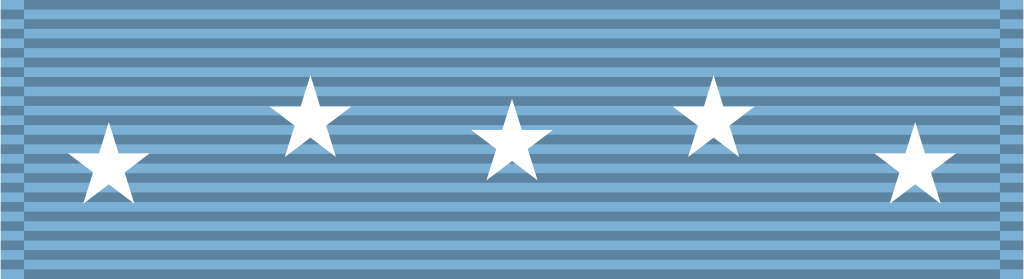
MH — Air Force
Base Points
100
Valor Points
100
Precedence
#1
Tier
1
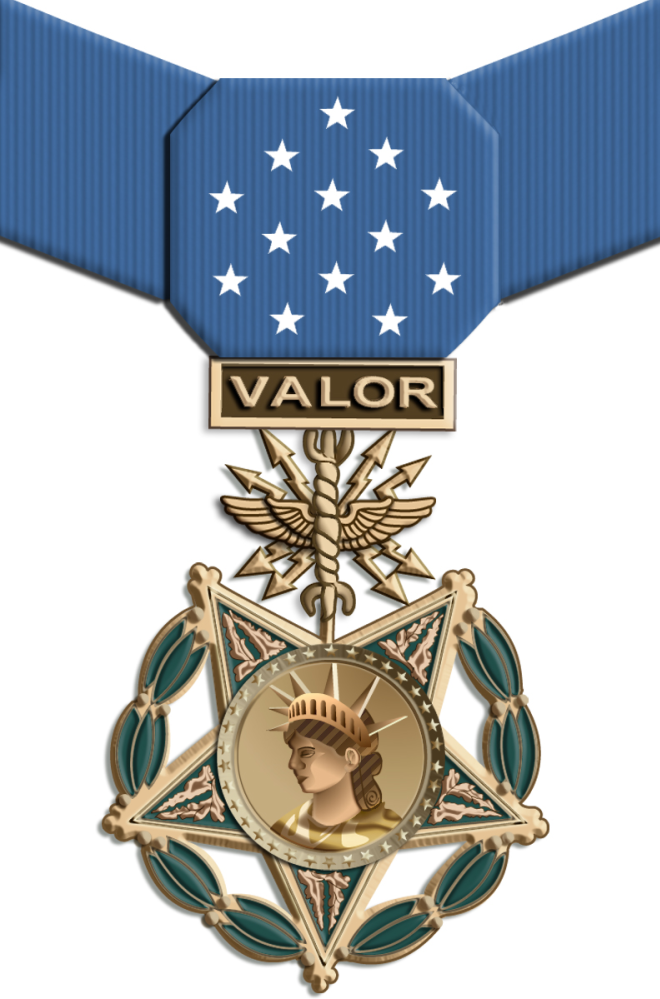
Air Force Medal of Honor
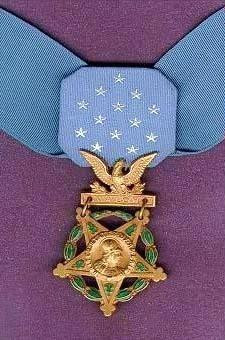
Army Medal of Honor
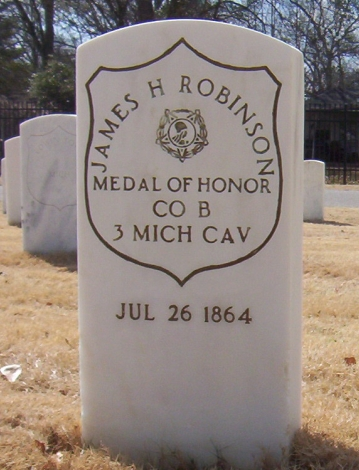
James H. Robinson gravestone, Medal of Honor, Company B, 3rd Michigan Cavalry, 26 July 1864 (cropped)

Medal Of Honor Rosette Lapel Button
Summary
The Medal of Honor (MOH) is the highest military decoration of the United States Armed Forces and is awarded to recognize American soldiers, sailors, marines, airmen, guardians, and coast guardsmen who have distinguished themselves by acts of valor. The medal is normally awarded by the president of the United States (the commander in chief of the armed forces) and is presented "in the name of Congress." It is often referred to as the Congressional Medal of Honor (CMOH), though the official name of the award is simply "Medal of Honor." There are three distinct variants of the medal: one for the Department of the Army, awarded to soldiers; one for branches of the Department of the Navy, awarded to sailors, marines, and coast guardsmen; and one for military branches of the Department of the Air Force, awarded to airmen and guardians. The Medal of Honor was introduced for the Naval Service in 1861, soon followed by the Army's version in 1862. The Air Force used the Army's version until they received their own distinctive version in 1965. The Medal of Honor is the oldest continuously issued combat decoration of the United States Armed Forces. The president typically presents the Medal of...
Catalog description
Highest military decoration awarded by the United States government
Main article: List of Medal of Honor recipients On This Day In History: The Medal of Honor was created in 1862. The first Medals of Honor were awarded and presented to six U.S. Army soldiers ("Andrews Raiders") on March 25, 1863, by Secretary of War Edwin Stanton, in his office of the War Department. Private Jacob Parrott, a U.S. Army volunteer from Ohio, became the first Medal of Honor recipient, awarded for his volunteering for and participation in a raid on a Confederate train in Big Shanty, Georgia, on April 12, 1862, during the American Civil War. After the medal presentations, the six decorated soldiers met with President Lincoln in the White House. Bernard John Dowling Irwin was the first (chronologically by action) Medal of Honor recipient during the Apache Wars. His actions on February 13, 1861, are the earliest for which the Medal of Honor was awarded. The first U.S. Navy sailors were awarded the Medal of Honor on April 3, 1863. 41 sailors received the award, with 17 awards for action during the Battle of Forts Jackson and St. Philip. The first marines awarded the Medal of Honor were John F. Mackie and Pinkerton R. Vaughn on July 10, 1863; Mackie for USS Galena on May 15, 1862, and Vaughn for USS Mississippi on March 14, 1863. The first, and so far only, Coast Guardsman to be awarded the Medal of Honor was Signalman First Class Douglas Munro. He was posthumously awarded it on May 27, 1943, for evacuating 500 marines under fire on September 27, 1942, during the Battle of Guadalcanal. The only woman awarded the Medal of Honor is Mary Edwards Walker, who was a civilian Army acting assistant surgeon during the American Civil War. She received the award in 1865 after the Judge Advocate General of the Army determined that she could be given a retroactive commission or brevet, but Secretary of War Stanton ruled against her in spite of this legal advice. Instead of a commission, President Andrew Johnson directed that "the usual medal of honor for meritorious services be given her." Evidently, Johnson did not know that the award was restricted by law to soldiers, which made the award to a contract surgeon (a civilian) unlawful. This defect later led to the award's revocation in 1917, and then questionable reinstatement by the Army's Board for Correction of Military Records in 1977. The reinstatement is often attributed to President Jimmy Carter, in error. The first black recipients of the Medal of Honor were sixteen Army soldiers and sixteen Navy sailors that fought during the Civil War. The first black recipient was Robert Blake, who received the medal on April 16, 1864 for serving as a powder boy on the USS Marblehead. The first Army award was announced on April 6, 1865, to twelve black soldiers from the five regiments of U.S. Colored Troops who fought at New Market Heights outside of Richmond on September 29, 1864. The first action by a black man to eventually earn the Medal of Honor was by William Harvey Carney. He earned the Medal during the Battle of Fort Wagner, but was not presented with it until 1900. President Dwight D. Eisenhower congratulates SSG Miyamura after having awarded him the Medal of Honor on October 27, 1953.The only Medal of Honor to be classified as "top secret" was awarded to Hiroshi "Hershey" Miyamura for his actions on April 24, 1951, during the Korean War when he was presumed dead. The Medal of Honor, which had not been publicly announced, was classified as top secret for his protection until his release in August 1953. The 1917 Medal of Honor Board revoked 911 awards, but only 910 names from the Army's Medal of Honor list, including awards to Mary Edwards Walker, William F. "Buffalo Bill" Cody and the first of two awards issued February 10, 1887, to George W. Mindil, who retained his award issued October 25, 1893. None of the 911 impacted recipients were ordered to return their medals, although on the question of whether the recipients could continue to wear their medals, the Judge Advocate General advised the Medal of Honor Board that the Army was not obligated to police the matter. Walker continued to wear her medal until her death, although some authors mistakenly claim that the Army sought its return. Although some sources claim that President Jimmy Carter formally restored her medal posthumously in 1977, this action was actually taken unilaterally by the Army's Board for Correction of Military Records. The Army Board for Correction of Military Records also restored the Medals of Honor of Buffalo Bill and four other civilian scouts in 1989.
Sixty-one Canadians who served in the United States Armed Forces earned the Medal of Honor, most during the American Civil War. Since 1900, four Canadians have received the medal. The only Canadian-born, naturalized U.S. citizen to receive the medal for heroism during the Vietnam War was Peter C. Lemon. While the governing statute for the Army's Medal of Honor (10 U.S.C. § 6241), beginning in 1918, explicitly stated that a recipient must be "an officer or enlisted man of the Army", "distinguish himself conspicuously by gallantry and intrepidity at the risk of his life above and beyond the call of duty", and perform an act of valor "in action involving actual conflict with an enemy", exceptions have been made:
Charles Lindbergh, 1927, civilian pilot, and U.S. Army Air Corps reserve officer. Lindbergh's medal was authorized by a special act of Congress, which effectively waived his ineligibility on the grounds of not being on military duty, not performing an act of gallantry, and not being in action (combat) against an enemy. Lindbergh's award also violated President Coolidge's executive order prohibiting multiple awards for the same action, as he also received a Distinguished Flying Cross for the same transatlantic flight. Major General (Retired) Adolphus Greely was awarded the medal in 1935, on his 91st birthday, "for his life of splendid public service." The result of a special act of Congress similar to Lindbergh's, Greely's medal citation did not reference any acts of valor. Foreign unknown recipients include five WWI Unknowns: the Belgian Unknown Soldier, the British Unknown Warrior, the French Unknown Soldier, the Italian Unknown Soldier, and the Romanian Unknown Soldier. U.S. unknown recipients include one each from four wars: World War I, World War II, Korea, and Vietnam. The Vietnam Unknown was later identified as Air Force First Lieutenant Michael Blassie through the use of DNA identification. Blassie's family asked for his Medal of Honor, but the Department of Defense denied the request in 1998. According to Undersecretary of Defense Rudy de Leon, the medal was awarded symbolically to all Vietnam unknowns, not to Blassie specifically. The action also resulted in clarification of unknown medal awards in the FY2005 defense bill, which expressly stated such medals are "awarded to the member as a representative of the members of the armed forces who died in such war or other armed conflict and whose remains have not been identified, and not to the individual personally."
Awards by conflict
Conflict
Date
Medal count (3,530)
List article
Civil War
1861–1865
1,523
American Civil War Medal of Honor recipients
Indian Wars
1865–1891
426
Medal of Honor recipients for the Indian Wars
Korean Expedition
1871
15
Medal of Honor recipients in the Korean Expedition
Spanish–American War
1898
110
Medal of Honor recipients for the Spanish–American War
Second Samoan Civil War
1899
4
Medal of Honor recipients for the Samoan Civil War
Philippine–American War
1899–1902
86
Philippine–American War Medal of Honor recipients
Boxer Rebellion
1899–1901
59
Medal of Honor recipients for the Boxer Rebellion
Occupation of Veracruz
1914
56
Medal of Honor recipients for Veracruz
United States occupation of Haiti
1915–1934
8
Medal of Honor recipients for Haiti
Dominican Republic Occupation
1916–1924
3
Medal of Honor recipients for the Occupation of the Dominican Republic
World War I
1914–1918
126
Medal of Honor recipients for World War I
Occupation of Nicaragua
1912–1933
2
Medal of Honor recipients for Occupation of Nicaragua
World War II
1939–1945
472
Medal of Honor recipients for World War II
Korean War
1950–1953
146
Korean War Medal of Honor recipients
Vietnam War
1955–1975
268
Medal of Honor recipients for the Vietnam War
USS Liberty incident
1967
1
Medal of Honor recipients for the USS Liberty incident
Battle of Mogadishu
1993
2
Medal of Honor recipients for the Battle of Mogadishu
Iraq War
2003–2011
7
Medal of Honor recipients for the Iraq War
War in Afghanistan
2001–2021
20
Medal of Honor recipients for the War in Afghanistan
Operation Inherent Resolve
2014–present
1
Medal of Honor recipients for Operation Inherent Resolve
Venezuelan Intervention
2026
1
Medal of Honor recipients for Venezuelan Intervention
Noncombat
1865–1939
193
Medal of Honor recipients in non-combat incidents
Unknown soldiers
1914–1973
9
Unknown Medal of Honor recipients (4 American and 5 Allies)
Awards by military branch
Army
Navy
Marine Corps
Air Force
Coast Guard
Total
2,461
749
300
19
1
3,530
Note that the number of Air Force recipients does not count recipients from its pre-September 19, 1947, Army-related predecessor organizations. Nevertheless, the Air Force's transfer agreement gave it retroactive jurisdiction over military awards to the date the Air Corps was authorized by statute: Jul. 2, 1926. Thus, were a decoration submitted retroactively for an aviator's actions on or after that date (including a Medal of Honor), it would be processed by the Air Force despite the fact that the Air Force did not yet exist as a separate service.
Double recipients Nineteen service members have been awarded the Medal of Honor twice. The first double Medal of Honor recipient was Thomas Custer (brother of George Armstrong Custer) for two separate actions that took place several days apart during the American Civil War.
Five "double recipients" were awarded both the Army's and Navy's Medal of Honor for the same action, with all five of these occurrences taking place during World War I. This was a consequence of the marine recipients serving under Army command, which had been reviewed by the Army's judge advocate general. According to the judge advocate general, the marines were "a party 'of the Army'" since they were detached for service under the Army by presidential directive, and thus were subject to the Army's decoration statutes for that time period. No modern recipients have more than one medal because of laws passed for the Army in 1918, and for the Navy in 1919, which stipulated that "no more than one medal of honor . . . shall be issued to any one person," although subsequent awards were still authorized by issuance of bars or other devices in lieu of the medal itself. The prohibition on wearing multiple medals did not technically apply to the double recipients of WWI because they received Medals of Honor from different services, which meant the same medals were not duplicated and had independent statutory authority. Later, in 1927, President Coolidge issued an executive order that forbade issuing more than one federal decoration for the same action, a policy that continues through the present time. The statutory bar on issuing multiple Medals of Honor was finally repealed in the FY2014 defense bill, at the request of the Office of the Secretary of Defense, meaning that recipients can now be issued more than one medal rather than simply receiving a device for subsequent awards. However, it is still true that no more than one medal may be issued for the same action.
The most Medals of Honor earned by any service member is two. The last living individual to be awarded two Medals of Honor was John J. Kelly, on October 3, 1918; the last individual to receive two Medals of Honor for two different actions was Smedley Butler, in 1914 and 1915. None of the double awardees earned two distinct medals under modern Medal of Honor criteria, although the WWI awardees qualified under substantially modern statutes.
Name
Service
Rank
War(s)
Notes
Frank Baldwin Army First Lieutenant, Captain American Civil War, Indian Wars
Smedley Butler Marine Corps Major Veracruz, Haiti
John Cooper Navy Coxswain American Civil War
Louis Cukela Marine Corps Sergeant World War I Awarded both Navy and Army versions for same action.
Thomas Custer Army Second Lieutenant American Civil War Battle of Namozine Church on April 3 and Battle of Sayler's Creek on April 6, 1865.
Daniel Daly Marine Corps Private, Gunnery Sergeant Boxer Rebellion, Haiti
Henry Hogan Army First Sergeant Indian Wars
Ernest A. Janson Marine Corps Gunnery Sergeant World War I Both awarded for same action. Received the Army MOH under the name Charles F. Hoffman.
John J. Kelly Marine Corps Private World War I Both awarded for same action.
John King Navy Water tender Peacetime 1901 and 1909
Matej Kocak Marine Corps Sergeant World War I Both awarded for same action.
John Lafferty Navy Fireman, First Class Fireman American Civil War, peacetime
John C. McCloy Navy Coxswain, Chief Boatswain Boxer Rebellion, Veracruz
Patrick Mullen Navy Boatswain's Mate American Civil War
John H. Pruitt Marine Corps Corporal World War I Both awarded for same action.
Robert Sweeney Navy Ordinary Seaman Peacetime 1881 and 1883
Albert Weisbogel Navy Captain of the Mizzen Top Peacetime 1874 and 1876
Louis Williams Navy Captain of the Hold Peacetime 1883 and 1884. Also known as Ludwig Andreas Olsen.
William Wilson Army Sergeant Indian Wars
Related recipients Arthur MacArthur, Jr. and Douglas MacArthur were the first father and son to be awarded the Medal of Honor. The only other such pairing is Theodore Roosevelt, Jr. (awarded in 2001) and Theodore Roosevelt III. Notably, one member in each pair was strongly influenced by political considerations; Douglas MacArthur's medal was approved for service (rather than gallantry) in violation of both law and policy that prohibited such action, and Theodore Roosevelt's medal was approved after members of Congress successfully lobbied the Secretary of the Army to reverse a prior determination that "Theodore Roosevelt's bravery in battle did not rise to the level that would justify the Medal of Honor and, indeed, it did not rise to the level of men who fought in that engagement."
Seven pairs of brothers have received the Medal of Honor:
James Pond and George F. Pond, in the American Civil War for separate actions. James for actions on 6 October 1863 and George on 15 May 1864. George N. Galloway and John Galloway, in the American Civil War for separate actions. George for actions on May 8, 1864 and John for actions on April 7, 1865. John and William Black, in the American Civil War. The Blacks are the first brothers to be so honored. Charles and Henry Capehart, in the American Civil War, the latter for saving a drowning man while under fire. Antoine and Julien Gaujot. The Gaujots also have the unique distinction of receiving their medals for actions in separate conflicts, Antoine in the Philippine–American War and Julien when he crossed the Mexican border to rescue Mexicans and Americans in a Mexican Revolution skirmish. Harry and Willard Miller, during the same naval action in the Spanish–American War. Allen and James Thompson, in the same American Civil War action. Two other notable pairs of related recipients include two uncle and nephew recipients. Admiral Frank Friday Fletcher (rear admiral at the time of award) and his nephew, Admiral Frank Jack Fletcher (lieutenant at the time of award), both awarded for actions during the United States occupation of Veracruz. Guy W. S. Castle for actions during the U.S. occupation of Veracruz, and his nephew Frederick Walker Castle for actions during World War II.
Late awards Since 1979, 86 late Medal of Honor awards have been presented for actions from the Civil War to the Vietnam War. In addition, five recipients whose names were included on the Army's medal revocations in 1917 had their awards restored. A 1993 study commissioned by the U.S. Army investigated "racial disparity" in the awarding of medals. At the time, no Medals of Honor had been awarded to U.S. soldiers of African descent who served in World War II. After an exhaustive review, the study recommended that ten Distinguished Service Cross recipients be awarded the Medal of Honor. On January 13, 1997, President Bill Clinton presented the Medal of Honor to seven of these World War II veterans, six of them posthumously and one to former Second Lieutenant Vernon Baker.
In 1998, a similar study of Asian Americans resulted in Clinton presenting 22 Medals of Honor in 2000. This was following a historical review conducted by a team of historians headed by Jim McNaughton at the Defense Language Institute Foreign Language Center, located in the Presidio of Monterey, California. The review ultimately forwarded at least 47 cases of Distinguished Service Crosses for potential upgrade, as well as one Silver Star. Twenty of the resulting medals went to U.S. soldiers of Japanese descent of the 442nd Regimental Combat Team (442nd RCT) who served in the European Theater of Operations during World War II. One of these Medal of Honor recipients was Senator Daniel Inouye, a former U.S. Army officer in the 442nd RCT.
In 2005, President George W. Bush presented the Medal of Honor to Tibor Rubin, a Hungarian-born American Jew who was a Holocaust survivor of World War II and enlisted U.S. infantryman and prisoner of war in the Korean War, whom many believed to have been overlooked because of his religion.
On April 11, 2013, President Obama presented the Medal of Honor posthumously to Army chaplain Captain Emil Kapaun for his actions as a prisoner of war during the Korean War. This follows other awards to Army Sergeant Leslie H. Sabo, Jr. for conspicuous gallantry in action on May 10, 1970, near Se San, Cambodia, during the Vietnam War and to Army Private First Class Henry Svehla and Army Private First Class Anthony T. Kahoʻohanohano for their heroic actions during the Korean War.
As a result of a congressionally mandated review to ensure brave acts were not overlooked due to prejudice or discrimination, on March 18, 2014, President Obama upgraded Distinguished Service Crosses to Medals of Honor for 24 Hispanic, Jewish and black individuals—the "Valor 24"—for their actions in World War II, the Korean War and the Vietnam War. Three were still living at the time of the ceremony.
In 2010 and again in 2014, Congress directed the Department of Defense to "survey military leaders . . . to the lowest level of command to determine if there is a trend of downgrading awards . . . for medals related to acts of valor and gallantry," and also to "review the Medal of Honor process to ensure that the nomination process, valor requirements, and timeliness of the process do not unfairly penalize service members." This ultimately resulted in a review of all post 9/11 valor awards, several of which resulted in Medals of Honor.
Another historical review for World War I medals that may have been tainted by discrimination was authorized in the FY2021 National Defense Authorization Act. Conducted under the George S. Rob Centre at Park University, the review is still ongoing but has already identified some 200 medals for potential upgrade.
^ Mears 2018, p. 24.
^ Cite error: The named reference MWxviii was invoked but never defined (see the help page).
^ Stealing the General: Great Locomotive Chase and The First Medal of Honor, ISBN 1-59416-033-3, 2006, by Russell S. Bonds
^ "History of the Medal | Medal of Honor Convention". www.mohconvention.com.
^ Comerford, Tim. "A Matter of Honor – History of the Medal of Honor". Archived from the original on August 3, 2020. Retrieved November 5, 2019.
^ "Cpl Mackie's Actions (G.O. 17: July 10, 1863. 2 marines awarded the MOH)". U.S. Marine Corps, Marine Corps Recruiting Command, 1st Marine Corps District. Archived from the original on March 27, 2019. Retrieved April 10, 2019.
^ "John Freeman Mackie | U.S. Civil War | U.S. Marine Corps | Medal of Honor Recipient". Congressional Medal of Honor Society. Retrieved March 23, 2026.
^ "Pinkerton Ross Vaughn | U.S. Civil War | U.S. Marine Corps | Medal of Honor Recipient". Congressional Medal of Honor Society. Retrieved March 23, 2026.
^ Collier & Del Calzo 2006, p. 19
^ Mears 2018, p. 167.
^ Dwight Mears, “’Neither an Officer nor an Enlisted Man’: Contract Surgeons’ Eligibility for the Medal of Honor,” Journal of Military History 85 (2021): 55.
^ Mikaelian & Wallace 2003, p. 8
^ Dwight Mears, “’Neither an Officer nor an Enlisted Man’: Contract Surgeons’ Eligibility for the Medal of Honor,” Journal of Military History 85 (2021): 57, 60.
^ a b Mears 2018, p. 171.
^ US Navy General Order No. 32, April 16, 1864.
^ Cite error: The named reference Schubert was invoked but never defined (see the help page).
^ "Massachusetts Historical Society: Object of the Month".
^ "William Harvey Carney | U.S. Civil War | U.S. Army | Medal of Honor Recipient".
^ "Hiroshi "Hershey" Miyamura". Medal of Honor Valor Trail. Retrieved October 22, 2023.
^ Mears 2018, pp. 53, 55.
^ Dwight Mears, “’Neither an Officer nor an Enlisted Man’: Contract Surgeons’ Eligibility for the Medal of Honor,” Journal of Military History 85 (2021): 60.
^ Melissa Winn, "I Wear My Own Clothes," Military Images, 2024, Vol.42, p.70
^ "About Whitman-Walker Clinic". Our History/Our Namesakes. Whitman-Walker Clinic. Archived from the original on July 1, 2015. Retrieved March 29, 2015.
^ Mears 2018, p. 175.
^ "Canada honours winners of top U.S. medal". CBC News. July 1, 2005. Archived from the original on May 29, 2007. Retrieved July 20, 2006.
^ "Thousands of Canadians, including a Medal of Honor winner, served with the U.S. military in Vietnam". Veterans With a Mission. July 1, 2005. Archived from the original on May 29, 2007. Retrieved July 20, 2006.
^ a b Cite error: The named reference Act of July 9, 1918, 40 Stat. 870 was invoked but never defined (see the help page).
^ "An Act Authorizing the President of the United States to present in the name of Congress a medal of honor to Colonel Charles A. Lindbergh", December 14, 1927, HR 3190, Public Law 1, 45 Stat. 1
^ a b c Mears 2018, p. 91.
^ William Putnam, Arctic Superstars: The Scientific Exploration and Study of High Mountain Elevations and of the Regions Lying Within or about the Arctic and Antarctic Circles (Boulder, CO: American Alpine Club, 2001), 171.
^ "Medal of Honor Recipients – Authorized by Special Acts of Congress". History.army.mil. Archived from the original on August 14, 2011. Retrieved May 26, 2012.
^ War Department General orders, No. 59, December 13, 1921, Sec. I
^ Approved March 9, 1948, Public Law 438, Eightieth Congress
^ Approved August 31, 1957, Public Law 85-251 Eighty-fifth Congress
^ Approved May 25, 1984, Public Law 98-301, Ninety-eighth Congress
^ a b "Vietnam Unknown's Medal of Honor Transfer Denied".
^ "Medal of Honor Won't Join Once-unknown Pilot". Chicago Tribune. August 23, 1998.
^ Mears 2018, p. 116.
^ Department of Defense, Military Awards for Valor - Top 3, https://valor.defense.gov/, verified May 16, 2023
^ "Medal of Honor Society FAQ". Archived from the original on May 22, 2021. Retrieved May 22, 2021.
^ This number is off by one – 3d Class Boy George Hollat had his Civil War medal revoked for desertion
^ Joint Army and Air Force Adjustment Regulations No. 1-11-53, Dec. 20, 1948, para. 2(b)
^ Tucker 2012, p. 2,359
^ "Medal of Honor Recipients: Thomas W. Custer". United States Army Center of Military History. Archived from the original on June 29, 2019. Retrieved September 28, 2015.
^ "Medal of Honor Statistics". History.army.mil. Archived from the original on August 9, 2011. Retrieved May 12, 2012.
^ Mears 2018, p. 76.
^ Mears 2018, pp. 219, 221.
^ Mears 2018, p. 80, 91.
^ Pub. L. 113–66 (2013), 127 Stat. 766
^ a b Mears 2018, p. 130.
^ Cite error: The named reference navyfaq was invoked but never defined (see the help page).
^ "John Joseph Kelly | World War I | U.S. Marine Corps | Medal of Honor Recipient".
^ "Smedley Darlington Butler | Haitian Campaign 1915 | U.S. Marine Corps | Medal of Honor Recipient".
^ "Scott, Stephen W.", (2009) Sergeant Major Dan Daly; The Most Outstanding Marine of all Time. Publishamerica Publishers. ISBN 1-60836-465-8.
^ a b "MOAA - Meet the Only Father-Son Medal of Honor Recipients". October 10, 2019.
^ Mears 2018, p. 143-145.
^ Mears 2018, p. 154.
^ a b c d e f g "7 Sets of Medal of Honor Siblings: Literal Brothers in Arms". August 31, 2022.
^ "Mexican Campaign (Vera Cruz)". Congressional Medal of Honor Society. April 21, 1914. Retrieved March 2, 2026.
^ "Guy Wilkinson stuart Castle | Mexican Campaign (Vera Cruz) | U.S. Navy | Medal of Honor Recipient".
^ "Frederick Walker Castle | World War II | U.S. Army Air Corps | Medal of Honor Recipient".
^ Congressional Research Service, Medal of Honor Recipients: 1979–2014, Anne Leland, Information Research Specialist, December 2, 2014, https://sgp.fas.org/crs/misc/RL30011.pdf Archived 2015-09-24 at the Wayback Machine. The report lists the late awards until the end of 2014. seven additional late awards have been presented at the White House, three by President Obama in 2015 and 2016 and four by President Trump in 2017 and 2018. Not included as a late award is the award to the Vietnam Unknown in 1984 by President Reagan.
^ "WWII black MOH recipients". United States Army Center of Military History. Archived from the original on November 10, 2010. Retrieved July 20, 2006.
^ a b Collier & Del Calzo 2006, p. 25
^ a b Rudi Williams (June 28, 2000). "22 Asian Americans Inducted into Hall of Heroes". American Forces Press Service. United States Department of Defense. Archived from the original on December 24, 2015. Retrieved March 9, 2013.
^ McNaughton, Edwards, Price, "'Incontestable Proof Will Be Exacted': Historians, Asian Americans, and the Medal of Honor," Public Historian 24 (Fall 2002), 19.
^ McNaughton, et. al, 'Incontestable Proof Will Be Exacted,' 29-30.
^ Gregg K. Kakesako (June 21, 2000). "Today, an old wrong is righted as 22 Asian-American heroes are awarded the nation's highest honor for bravery in battle". Honolulu Star-Bulletin. Archived from the original on October 27, 2014. Retrieved March 9, 2013.
^ Nguyen Huy Vu (October 18, 2005). "Medal of Honor recipient just did duty". Orange County Register. Archived from the original on December 13, 2014. Retrieved March 9, 2013. Tom Tugend (May 16, 2002). "Pentagon Reviews Jewish Veteran Files". Jewish Journal. Archived from the original on July 1, 2015. Retrieved September 28, 2015. "Corporal Tibor Rubin, Korean War Veteran". Medal of Honor Corporal Tibor Rubin. United States Army. February 1, 2013. Archived from the original on January 21, 2013. Retrieved March 9, 2013.
^ Barack Obama (2013). Army Chaplain Gets Posthumous Medal of Honor. Associated Press. Archived from the original on April 20, 2013. Retrieved April 16, 2013. "Medal of Honor for US Army chaplain Father Kapaun". BBC News. April 11, 2013. Archived from the original on April 14, 2013. Retrieved April 16, 2013. Krissah Thompson (April 11, 2013). "Obama awards Kapaun Medal of Honor". Washington Post. Archived from the original on April 14, 2013. Retrieved April 16, 2013.
^ "GI killed in Vietnam War receives Medal of Honor". CBS News. May 16, 2012. Archived from the original on May 17, 2012. Retrieved May 16, 2012.
^ Marsh, Wendell (May 2, 2011). "Two Korean War vets receive Medal of Honor posthumously". Reuters. Archived from the original on May 6, 2011.
^ a b • "Valor 24 / Medal of Honor / World War II Korean War Vietnam War" (PDF). U.S. Army Combined Arms Center. March 18, 2014. Archived from the original (PDF) on July 14, 2014. Retrieved June 3, 2014. • List with basic details is at U.S. Army's List of Recipients .
^ a b Mears 2018, p. 129-134.
^ Sec 584, Pub. L. 116-92, 133 Stat. 1412.
^ Park University, Valor Medals Review Project.
} template (see the help page).
Medal of Honor (without the suspension ribbon) awarded to Seaman John Ortega in 1864. Medal of Honor awarded posthumously in 1866 to John Morehead Scott, one of the Andrews Raiders In 1861, early in the American Civil War, a proposal for a battlefield decoration for valor was submitted to Lieutenant General Winfield Scott, the Commanding General of the United States Army, by Lieutenant Colonel Edward D. Townsend, an assistant adjutant at the Department of War and Scott's chief of staff. Scott, however, was strongly against the American republic's awarding medals for valor, a European monarchical tradition. After Scott retired in October 1861, however, Secretary of the Navy Gideon Welles adopted the idea of a decoration to recognize and honor distinguished naval service.
On December 9, 1861, Iowa Senator James W. Grimes, Chairman on the Committee on Naval Affairs, introduced bill S. 82. The bill included a provision authorizing 200 "medals of honor," "to be bestowed upon such petty officers, seamen, landsmen, and marines as shall most distinguish themselves by their gallantry in action and other seaman-like qualities during the present war...." On December 21, the bill was passed and signed into law by President Abraham Lincoln. Secretary Welles directed the Philadelphia Mint to design the new military decoration. On May 15, 1862, the United States Department of the Navy ordered 175 medals ($1.85 each) from the U.S. Mint in Philadelphia with "Personal Valor" inscribed on the back of each one.
On February 15, 1862, Senator Henry Wilson, the chairman of the Senate Committee on Military Affairs and the Militia, introduced a resolution (equivalent to a bill) for a Medal of Honor for the Army. The resolution (equivalent to a modern Act of Congress) was approved by Congress and signed into law on July 12, 1862. This measure provided for awarding a medal of honor "to such non-commissioned officers and privates as shall most distinguish themselves by their gallantry in action and other soldier-like qualities during the present insurrection." By mid-November the Department of War contracted with Philadelphia silversmith William Wilson and Son, who had been responsible for the Navy's design, to prepare 2,000 medals for the Army ($2.00 each) to be struck at the mint. The Army's version had "The Congress to" written on the back of the medal. Both versions were made of copper and coated with bronze, which "gave them a reddish tint."
On March 3, 1863, Congress made the Army Medal of Honor a permanent decoration by passing legislation permitting the award to such soldiers "as have most distinguished or who may hereafter most distinguish themselves in action." The same legislation also authorized the medal for officers of the Army. On March 25, 1863 the Secretary of War presented the first Medals of Honor to six U.S. Army volunteers in his office.
In 1896, the ribbon of the Army's version of the Medal of Honor was redesigned with all stripes being vertical. Again, in 1904 the planchet of the Army's version of the Medal of Honor was redesigned by General George Lewis Gillespie. The purpose of the redesign was to help distinguish the Medal of Honor from other medals, particularly the membership insignia issued by the Grand Army of the Republic.
In 1917, based on the report of the Medal of Honor Review Board, established by Congress in 1916, 911 recipients were stricken from the Army's Medal of Honor list because the medal had been awarded inappropriately. Among them were William Frederick "Buffalo Bill" Cody and Mary Edwards Walker. In 1977, the Army's board for correction of military records unilaterally restored Walker's medal at the request of a relative. The board had no authority to overturn a statute, and the restoration violated not only the period law during the Civil War, but also the law requiring revocation in 1916, and modern law in 1977. As a reaction to Walker's restoration, a relative of Cody's requested the same action from the Army's board for correction, and it reinstated the medals for Cody and four other civilian scouts on June 12, 1989. Subsequent litigation over the Garlin Conner award, which was recommended by the Army's board for correction of military records in 2015, established that the correction boards lack the authority to unilaterally award Medals of Honor. In Conner's case, the board merely recommended the medal, which was then referred to the Senior Army Decorations Board, and ultimately to the Secretary of the Army, the Secretary of Defense, and the President, who requested a waiver be passed by Congress.
A separate Coast Guard Medal of Honor was authorized in 1963 but was not designed or awarded. A separate design for a version of the medal for the Department of the Air Force was authorized in 1956, designed on April 14, 1965, and first awarded in January 1967. Previously, airmen of the U.S. Air Force received the Army's version of the medal.
^ a b c Mears 2018, p. 18.
^ "U.S. Senate: James Grimes: A Featured Biography". www.senate.gov. Archived from the original on July 19, 2017. Retrieved February 16, 2018.
^ a b 12 Stat. 329–330.
^ Above and Beyond. Boston Publishing Company. 1985. p. 5.
^ Mears 2018, p. 13.
^ Bonds, Russell S. (2006). Stealing the General: Great Locomotive Chase and The First Medal of Honor. Westholme. p. 308. ISBN 1-59416-033-3.
^ "Two Chief Engineers Were Medal of Honor Recipients?". Did You Know?. U.S. Army Corps of Engineers. Archived from the original on August 18, 2006. Retrieved July 29, 2006.
^ Mikaelian & Wallace 2003, p. xviii
^ "Types of the Medal of Honor: 1862 To Present". Congressional Medal of Honor Society. Archived from the original on August 10, 2011. Retrieved March 14, 2012.
^ Above and Beyond: A History of the Medal of Honor and the Civil War. Boston Publishing Company in cooperation with the CMOH Society. 1985. p. 5. ISBN 0-939526-19-0. These medals were made of copper and coated with bronze
^ a b c 37th Congress, Second Session; Resolution No. 52, 12 Stat. 623–624
^ Above and Beyond. Boston Publishing Company. 1985. p. 5. 2nd paragraph.
^ Bonds, Russell S. (2006). Stealing the General, The Great Locomotive Chase and the First Medal of Honor. Westholme. p. 309. ISBN 978-1-59416-033-2. The medal of honor is bronze, of neat device, and is highly prized by those of whom it has been bestowed," Townsend wrote in an 1864 report. Its original design, embodied first in the Navy Medal, was an inverted, five-pointed star ...
^ Above and Beyond: A History of the Medal of Honor from the Civil War to Vietnam. Boston Publishing Company in cooperation with the CMOH Society. 1985. p. 5. ISBN 0-939526-19-0. The medals were made of copper and coated with bronze, which gave them a reddish tint
^ Mears 2018, p. 21.
^ Above and Beyond. 1985. p. 5.
^ Bonds, Russell S. (2006). Great Locomotive Chase and the First Medal of Honor.
^ a b Hargis, Robert (August 20, 2012). World War II Medal of Honor Recipients (2): Army & Air Corps. Osprey Publishing. p. 3. ISBN 978-1-78200-207-9. Retrieved September 3, 2012.[permanent dead link]
^ Mollan, Mark C. (Summer 2001). "The Army Medal of Honor: The First Fifty-five Years". Prologue Magazine. 33 (2). Archived from the original on July 18, 2014. Retrieved September 3, 2014. Further depreciating the value of the medal, the Grand Army of the Republic and other veterans groups began giving out their own medals, some of which looked conspicuously similar to the Medal of Honor.
^ Comerford, Tim (February 5, 2016). "A Matter of Honor – History of the Medal of Honor". www.doncio.navy.mil. Department of the Navy. Archived from the original on October 31, 2016. Retrieved January 26, 2025. According to Frank, the Army redesigned its medal because other organizations had medals that looked similar. For example, the Grand Army of the Republic had a medal that, from far away, looked like a MoH.
^ Mears 2018, p. 53.
^ a b Mears 2018, p. 171.
^ Mears 2018, p. 175.
^ a b Mears 2018, p. 192.
^ "Medal of Honor, Frequently Asked Questions". Navy.mil. Archived from the original on June 5, 2012. Retrieved May 12, 2012.
^ Cite error: The named reference Pub. L. 88–77 1963, 77 Stat. 95 was invoked but never defined (see the help page).
^ An Act to Revise, Codify, and Enact into Law, Title 10 of the United States Code, Entitled “Armed Forces,” and Title 32 of the United States Code, Entitled “National Guard,” Pub. L. 84-1028 (1956), 70A Stat. 540
^ a b Cite error: The named reference af.mil was invoked but never defined (see the help page).
^ Mikaelian & Wallace 2003, p. xxvi
There are three versions of the Medal of Honor, one for each of the military departments of the Department of Defense (DoD): the Department of the Army, Department of the Navy (including the Navy, Marine Corps, and Coast Guard), and Department of the Air Force (Air and Space Forces). Members of the Coast Guard, part of the Department of Homeland Security, are eligible to receive the Naval version. Each medal is constructed differently, and the components are made from gilding metals and red brass alloys with some gold plating, enamel, and bronze pieces. The United States Congress considered a bill in 2004 which would require the Medal of Honor to be made with 90% gold, the same composition as the lesser-known Congressional Gold Medal, but the bill did not pass Congress.
Army Medal of HonorNaval Medal of HonorAir and Space Forces Medal of Honor Army variant The Army's version is described by the Institute of Heraldry as "a gold five-pointed star, each point tipped with trefoils, 1+1⁄2 inches [3.8 cm] wide, surrounded by a green laurel wreath and suspended from a gold bar inscribed VALOR, surmounted by an eagle. In the center of the star, Minerva's head surrounded by the words UNITED STATES OF AMERICA. On each ray of the star is a green oak leaf. On the reverse is a bar engraved THE CONGRESS TO with a space for engraving the name of the recipient." The pendant and suspension bar are made of gilding metal, with the eye, jump rings, and suspension ring made of red brass. The finish on the pendant and suspension bar is hard enameled, gold plated, and rose gold plated, with polished highlights.
Naval variant The Naval version is described as "a five-pointed bronze star, tipped with trefoils containing a crown of laurel and oak. In the center is Minerva, personifying the United States, standing with her left hand resting on fasces and her right hand holding a shield emblazoned with the shield from the coat of arms of the United States. She repulses Discord, represented by snakes (originally, she was repulsing the snakes of secession). The medal is suspended from the flukes of an anchor." It is made of solid red brass, oxidized and buffed.
Air and Space Forces variant The Air and Space Forces version is described as "within a wreath of green laurel, a gold five-pointed star, one point down, tipped with trefoils and each point containing a crown of laurel and oak on a green background. Centered on the star, an annulet of 34 stars is a representation of the head of the Statue of Liberty. The star is suspended from a bar inscribed with the word VALOR above an adaptation of Jupiter's thunderbolt from the Department of the Air Force's seal. The pendant is made of gilding metal. The connecting bar, hinge, and pin are made of bronze. The finish on the pendant and suspension bar is hard enameled, gold plated, and rose gold plated, with buffed relief.
Historic versions Main article: Tiffany Cross Medal of Honor The Medal of Honor has evolved in appearance over time. The inverted pentagram design of the Naval version's pendant adopted in early 1862 has not changed since its inception. The Army's 1862 version followed and was identical to the Naval version except an eagle perched atop cannons was used instead of an anchor to connect the pendant to the suspension ribbon. The medals featured a female allegory of the Union, with a shield in her right hand that she used to fend off a crouching attacker and serpents. In her left hand, she held a fasces. There are 34 stars surrounding the scene, representing the number of states in the union at the time. In 1896, the Army version changed the ribbon's design and colors due to misuse and imitation by nonmilitary organizations. In 1904, the Army "Gillespie" version introduced a smaller redesigned star and the ribbon was changed to the light blue pattern with white stars seen today. The 1904 Army version also introduced a bar with the word "Valor" above the star. In 1913, the Naval version adopted the same ribbon pattern.
After World War I, the Department of the Navy decided to separate the Medal of Honor into two versions, one for combat and one for non-combat. This was an attempt to circumvent the requirement enacted in 1919 that recipients participate "in action involving actual conflict with the enemy," which would have foreclosed non-combat awards. By treating the 1919 Medal of Honor as a separate award from its Civil War counterpart, this allowed the Department of the Navy to claim that it was not literally in violation of the 1919 law. The original upside-down star was designated as the non-combat version and a new pattern of the medal pendant, in cross form, was designed by the Tiffany Company in 1919. Secretary of the Navy Josephus Daniels selected Tiffany after snubbing the Commission of Fine Arts, which had submitted drawings that Daniels criticized as "un-American". The so-called Tiffany Cross was to be presented to a sailor or marine who "in action involving actual conflict with the enemy, distinguish himself conspicuously by gallantry and intrepidity at the risk of his life above and beyond the call of duty." Despite the "actual conflict" guidelines, the Tiffany Cross was awarded to Navy CDR (later RADM) Richard E. Byrd and Floyd Bennett for their flight to the North Pole in 1926. The decision was controversial within the Navy's Bureau of Navigation (which handled personnel administration), and officials considered asking the attorney general of the United States for an advisory opinion on the matter. Byrd himself apparently disliked the Tiffany Cross, and eventually requested the alternate version of the medal from President Herbert Hoover in 1930. The Tiffany Cross itself was not popular among recipients—one author reflected that it was "the most short-lived, legally contentious, and unpopular version of the Medal of Honor in American history." In 1942, in response to a lawsuit, the Department of the Navy requested an amendment to expressly allow noncombat awards of the Medal of Honor. When the amendment passed, the Department of the Navy returned to using only the original 1862 inverted 5-point star design and retired the Tiffany Cross.
In 1944, the suspension ribbons for both versions were replaced with the now-familiar neck ribbon. When the Air and Space Force's version was designed in 1965, it incorporated similar elements and design from the Army version. At the Department of the Air Force leadership's insistence, the new medal depicted the Statue of Liberty's image in place of Minerva on the medal and changed the connecting device from an eagle to Jupiter's thunderbolt flanked with wings as found on the Department of the Air Force's seal. The Air Force diverged from the traditional depiction of Minerva in part due to a desire to distinguish itself from the Army, including the Institute of Heraldry that traditionally designs awards, but which falls under the Army.
1862–1895 Army version
1896–1903 Army version
1904–1944 Army version
Post 1944 Army version
1862–1912 Navy version
1913–1942 Navy version
1919–1942 Navy "Tiffany Cross" version
Post 1942 Navy version
^ a b c "Medal of Honor Design Details - All Branches | CMOHS".
^ "History of the Medal of Honor – MOH Host City Program".
^ Martin, John (February 5, 2004). "Medal of Honor: Gold or Brass?". ABC News. Archived from the original on March 20, 2014. Retrieved September 21, 2012.
^ a b "Medal of Honor - Army". tioh.army.mil. Archived from the original on May 27, 2025. Retrieved September 30, 2025.
^ a b c d "Medal of Honor-Army". US Government. The Institute of Heraldry. Archived from the original on April 16, 2021. Retrieved December 7, 2020.
^ a b Defense Standardization Program Office. "Detail Specification Sheet MIL-DTL-3943/1G, Revision G, dated 29 May 2007 (PDF Document)". Assistdocs.com. Archived from the original on April 28, 2014. Retrieved November 15, 2012.
^ a b c d e f "Medal of Honor - Navy". The Institute of Heraldry. Archived from the original on April 16, 2021. Retrieved January 27, 2024.
^ Defense Standardization Program Office. "Detail Specification Sheet MIL-DTL-3943/2H, Revision H, dated 29 May 2007 (PDF Document)". Assistdocs.com. Archived from the original on July 1, 2015. Retrieved November 15, 2012.
^ a b c "Medal of Honor - Air Force".
^ a b c Defense Standardization Program Office. "Detail Specification Sheet MIL-DTL-3943/3G, Revision G, dated 29 May 2007 (PDF Document)". Assistdocs.com. Archived from the original on July 1, 2015. Retrieved November 15, 2012.
^ "U.S. Army Service, Campaign Medals and Foreign Awards Information".
^ a b Schubert, Frank N. (1997). Black Valor: Buffalo Soldiers and the Medal of Honor, 1870–1898. Scholarly Resources Inc. pp. 2, 6. ISBN 9780842025867.
^ a b c "Medals of Honor". history.navy.mil. Naval History and Heritage Command. Retrieved October 3, 2025.
^ Mears 2018, pp. 82, 221.
^ Mears 2018, pp. 82–83.
^ a b Mears 2018, p. 84.
^ Naval History & Heritage Command (January 23, 2008). "The Medal of Honor – Navy Medals of Honor, 1861–1941 – The Tiffany Cross pattern". Department of the Navy. Archived from the original on August 22, 2010. Retrieved November 30, 2012.
^ a b Mears 2018, p. 148.
^ Mears 2018, p. 149.
^ Mears 2018, p. 94.
^ Mears 2018, p. 95.
^ Cite error: The named reference af.mil was invoked but never defined (see the help page).
^ "Medal of Honor History". Exhibits. State Historical Society of Iowa. Archived from the original on September 28, 2013. Retrieved January 28, 2013.
}: CS1 maint: deprecated archival service (link)
^ a b Mears 2018, p. 114.
In 2011, Department of Defense (DOD) instructions in regard to the Medal of Honor were amended to read "for each succeeding act that would otherwise justify award of the [Medal of Honor], the individual receiving the subsequent award is authorized to wear an additional [Medal of Honor] ribbon or a "V" Device on the Medal of Honor suspension ribbon" (the "V" device is a 1⁄4-inch-high (6.4 mm) bronze miniature letter "V" with serifs that denotes valor). The Medal of Honor was the only decoration authorized to use the "V" device (none were ever issued) to designate subsequent awards in such a fashion. Nineteen individuals, all now deceased, were double Medal of Honor recipients. Effective December 2016, the relevant DOD manual was updated to read:
A separate MOH is presented to an individual for each succeeding act that justifies award. A member awarded more than one MOH will always wear a separate MOH or separate MOH ribbon to correspond with the number of awards received. The update further explicitly removed authorization for any device(s) on the MOH:
There are no attachments authorized for the MOH.
^ DoDM 1348.33-V1, November 23, 2010, Change 1, 10/12/2011, p.34.
^ "Double Recipients". Congressional Medal of Honor Society. Archived from the original on February 28, 2012. Retrieved March 14, 2012.
^ "Department of Defense Manual 1348.33, Volume 1" (PDF). Defense Technical Information Center. p. 10. Archived from the original (PDF) on December 2, 2025. Retrieved February 25, 2017. Alt URL